概述
Hodgkin Lymphoma (HL), formerly known as Hodgkin’s Disease, is a malignant cancer of the lymphatic system — part of the body’s immune defense network.
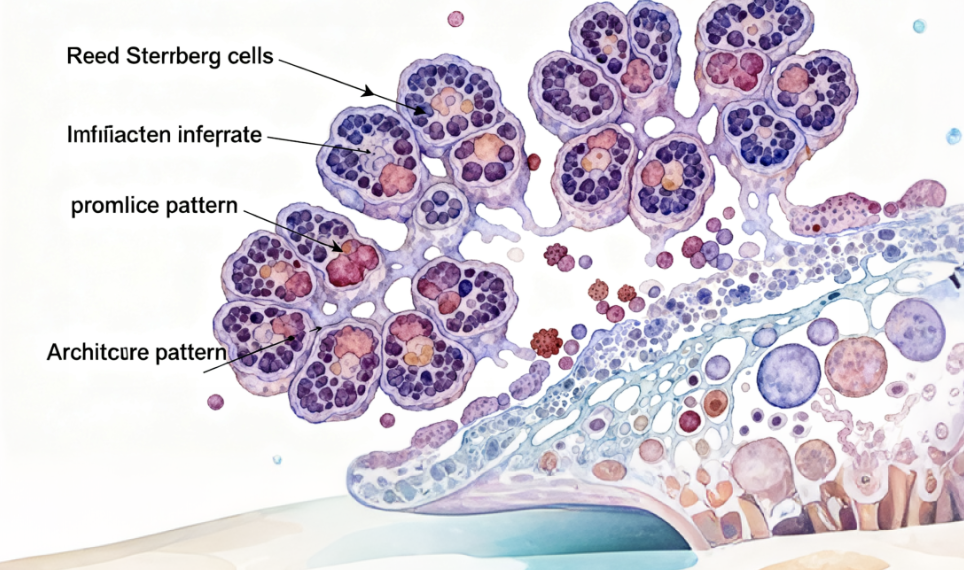
It arises from B lymphocytes (B-cells), which undergo abnormal transformation and form characteristic Reed–Sternberg cells, a diagnostic hallmark.
Hodgkin Lymphoma accounts for about 10% of all lymphomas and primarily affects young adults (ages 15–35) and older adults (>55 years).
It is one of the most curable cancers, especially when diagnosed early and treated with modern chemotherapy and targeted therapies.
症状
- Painless swelling of lymph nodes (neck, underarm, or groin)
- Persistent fatigue or weakness
- Unexplained fever
- Drenching night sweats
- Unintentional weight loss (>10% in 6 months)
- Itching (pruritus) without rash
- Pain in lymph nodes after alcohol intake (unique but rare symptom)
- Cough, chest pain, or shortness of breath if mediastinal nodes are enlarged
病因与风险因素
- Exact cause unknown, but associated with abnormal B-cell development.
- Risk factors include:
- Epstein–Barr Virus (EBV) infection
- Family history of lymphoma
- Male sex (slightly higher incidence)
- Weakened immune system (HIV/AIDS, organ transplant)
- Early adulthood or late adulthood age peaks
- Not inherited directly, but familial clustering may occur.
诊断方法
- Physical examination: Lymph node enlargement without tenderness
- Imaging:
- CT or PET-CT scan – assesses lymph node involvement and staging
- MRI – used for specific organ involvement
- Lymph node biopsy: Confirms diagnosis by identifying Reed–Sternberg cells (large, binucleate “owl’s eye” cells).
- Immunohistochemistry: Positive for CD15 and CD30 markers (classic HL).
- Blood tests: May show anemia, elevated ESR, or abnormal lymphocyte counts.
- Bone marrow biopsy: Performed in advanced disease or abnormal blood findings.
- Staging: Uses the Ann Arbor classification (Stage I–IV), considering “A” (no systemic symptoms) or “B” (with fever, night sweats, weight loss).
治疗方案
- Chemotherapy:
- Standard regimens: ABVD (Adriamycin, Bleomycin, Vinblastine, Dacarbazine) or AAVD (Adcetris®, Adriamycin, Vinblastine, Dacarbazine).
- 4–6 cycles depending on stage and response.
- Radiation therapy:
- Used for early-stage or bulky disease, often after chemotherapy.
- Modern techniques minimize exposure to heart and lungs.
- Targeted therapy:
- Brentuximab vedotin (anti-CD30 antibody-drug conjugate).
- Immunotherapy:
- Checkpoint inhibitors (nivolumab, pembrolizumab) used for relapsed or refractory disease.
- Stem cell transplantation:
- Autologous stem cell transplant for recurrent cases after remission induction.
- Clinical trials:
- Ongoing studies explore new immunotherapies and chemo-free regimens.
预后情况
- Highly curable – especially in early stages.
- Overall 5-year survival rate:
- Stage I–II: >90%
- Stage III–IV: ~70–85%
- Key prognostic factors: Stage, presence of “B symptoms,” bulky disease, and response to initial therapy.
- Relapse rate: <10% for early-stage disease after full treatment.
- Late effects: Cardiac or pulmonary toxicity (from chemo/radiation), secondary cancers, or infertility — minimized with modern treatment protocols.
与此类癌症共处
- Highly curable – especially in early stages.
- Overall 5-year survival rate:
- Stage I–II: >90%
- Stage III–IV: ~70–85%
- Key prognostic factors: Stage, presence of “B symptoms,” bulky disease, and response to initial therapy.
- Relapse rate: <10% for early-stage disease after full treatment.
- Late effects: Cardiac or pulmonary toxicity (from chemo/radiation), secondary cancers, or infertility — minimized with modern treatment protocols.
预防与筛查
- No specific screening test for the general population.
- Risk reduction: Avoid immunosuppression where possible and maintain general health.
- Early detection: Seek medical attention for persistent lymph node swelling or systemic “B” symptoms.
- Survivor care: Lifelong monitoring for late effects (thyroid function, cardiac health, secondary malignancies).
FAQs
Q: Is Hodgkin Lymphoma curable?
A: Yes. It’s one of the most curable cancers, with over 90% of early-stage patients achieving long-term remission.
Q: How is Hodgkin Lymphoma different from Non-Hodgkin Lymphoma?
A: HL has Reed–Sternberg cells and a more predictable pattern of spread, while Non-Hodgkin Lymphomas are more diverse and often spread randomly.
Q: Can it return after treatment?
A: Relapse can occur in a small percentage, but many relapsed cases are still curable with stem cell transplantation or immunotherapy.
Q: Is it contagious or hereditary?
A: No, it is not contagious and rarely hereditary.
相关资源
Q: Is Hodgkin Lymphoma curable?
A: Yes. It’s one of the most curable cancers, with over 90% of early-stage patients achieving long-term remission.
Q: How is Hodgkin Lymphoma different from Non-Hodgkin Lymphoma?
A: HL has Reed–Sternberg cells and a more predictable pattern of spread, while Non-Hodgkin Lymphomas are more diverse and often spread randomly.
Q: Can it return after treatment?
A: Relapse can occur in a small percentage, but many relapsed cases are still curable with stem cell transplantation or immunotherapy.
Q: Is it contagious or hereditary?
A: No, it is not contagious and rarely hereditary.