
Ductal Carcinoma In Situ (DCIS)
Overview
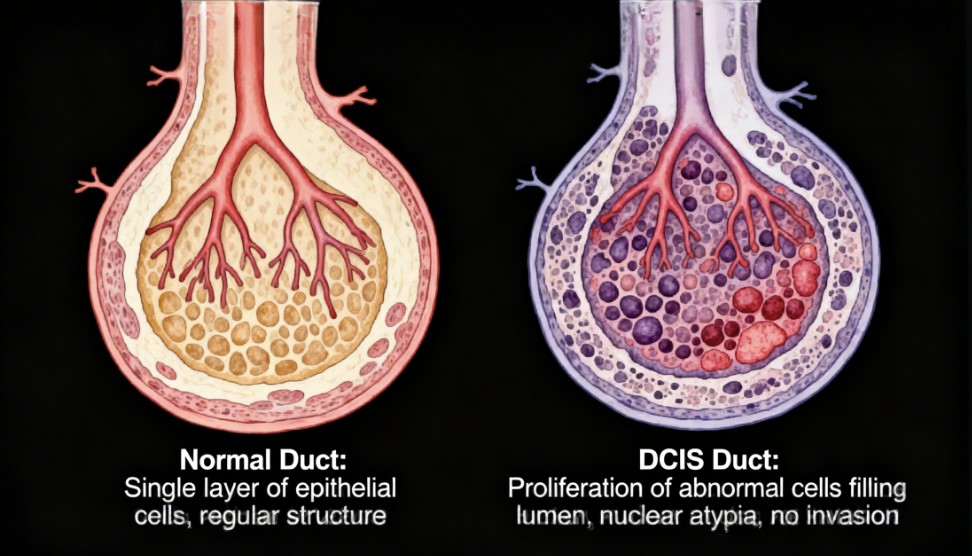
Ductal Carcinoma In Situ (DCIS) is a non-invasive form of breast cancer, meaning the abnormal cells are confined to the milk ducts and have not yet invaded the surrounding breast tissue.
It is sometimes referred to as Stage 0 breast cancer.
DCIS accounts for about 20–25% of all new breast cancer diagnoses and is typically found during routine mammography, as it often produces no palpable lump.
Although non-invasive, DCIS can progress to invasive ductal carcinoma (IDC) if untreated, making early detection and management critical.
Symptoms
- Usually asymptomatic (detected on screening mammogram)
- Microcalcifications visible on mammogram (most common finding)
- Occasionally:
- Breast lump or thickening
- Nipple discharge (especially bloody or clear)
- Rarely, skin changes or pain in localized area
Causes & Risk Factors
-
Exact cause: Uncontrolled proliferation of epithelial cells within the breast ducts that remain confined by the basement membrane.
Major risk factors include:
- Age: More common in women aged 50 and above
- Family history: Breast cancer in a first-degree relative
- Genetic mutations: BRCA1, BRCA2, or TP53 mutations
- Previous breast biopsies: Especially atypical hyperplasia or lobular carcinoma in situ
- Prolonged estrogen exposure: Early menarche, late menopause, hormone replacement therapy
- Obesity and alcohol consumption
- Radiation exposure to the chest in youth (e.g., prior lymphoma therapy)
Diagnosis
- Screening mammogram:
- Detects microcalcifications or architectural distortions.
- Diagnostic imaging:
- Breast ultrasound or MRI may be used to further evaluate suspicious areas.
- Biopsy:
- Core needle biopsy confirms the diagnosis.
- Pathology determines nuclear grade, presence of necrosis, and hormone receptor (ER/PR/HER2)
- Classification:
- Low-grade: Slow-growing, minimal risk of progression
- Intermediate-grade: Moderate cellular atypia
- High-grade: Rapidly proliferative, higher risk of becoming invasive
Treatment Options
- Screening mammogram:
- Detects microcalcifications or architectural distortions.
- Diagnostic imaging:
- Breast ultrasound or MRI may be used to further evaluate suspicious areas.
- Biopsy:
- Core needle biopsy confirms the diagnosis.
- Pathology determines nuclear grade, presence of necrosis, and hormone receptor (ER/PR/HER2)
- Classification:
- Low-grade: Slow-growing, minimal risk of progression
- Intermediate-grade: Moderate cellular atypia
- High-grade: Rapidly proliferative, higher risk of becoming invasive
Prognosis
- Excellent prognosis with appropriate treatment.
- 10-year survival rate: >98%
- Recurrence rate: 10–15% (about half of recurrences are invasive).
- Prognostic factors:
- Tumor grade and size
- Surgical margin status
- Hormone receptor positivity
- Patient age and treatment adherence
Living with this Cancer Type
- Excellent prognosis with appropriate treatment.
- 10-year survival rate: >98%
- Recurrence rate: 10–15% (about half of recurrences are invasive).
- Prognostic factors:
- ○ Tumor grade and size
- ○ Surgical margin status
- ○ Hormone receptor positivity
- ○ Patient age and treatment adherence
Prevention & Screening
- Routine mammography: Key to early detection.
- Risk reduction:
- Maintain healthy body weight and limit alcohol.
- Discuss risk-reducing medications if high-risk (e.g., tamoxifen for BRCA carriers).
- Genetic counseling and testing for strong family history.
- Early detection: DCIS is almost always curable when found at the in situ stage.
FAQs
Q: Is DCIS considered “real” cancer?
A: Yes — DCIS is a non-invasive form of breast cancer. It has malignant potential but has not yet spread beyond the ducts.
Q: Can DCIS turn into invasive cancer?
A: If untreated, some high-grade DCIS can progress to invasive ductal carcinoma, though not all cases will.
Q: Will I lose my breast?
A: Most DCIS patients are treated with lumpectomy + radiation and keep their breast. Mastectomy is reserved for extensive cases.
Q: Is chemotherapy needed?
A: No. DCIS does not require chemotherapy, as it is non-invasive.
Resources
- American Cancer Society (ACS) – cancer.org
- National Cancer Institute (NCI) – cancer.gov
- org – www.breastcancer.org
- Susan G. Komen Foundation – komen.org
- gov – Search “Ductal Carcinoma In Situ”
Understand Precision Testing
Learn how liquid biopsy and chemo sensitivity testing can personalize your treatment plan.
Make Informed Decisions
Gain knowledge to actively participate in treatment discussions with your healthcare team.
Improve Treatment Outcomes
Discover how precision medicine and metabolic therapies can enhance treatment effectiveness.
Start Your Educational Journey Today
Empower yourself with knowledge about precision metabolic oncology and take an active role in your cancer care journey.
Need More Information?
Our team of oncology experts is here to help you understand your diagnosis and treatment options.