

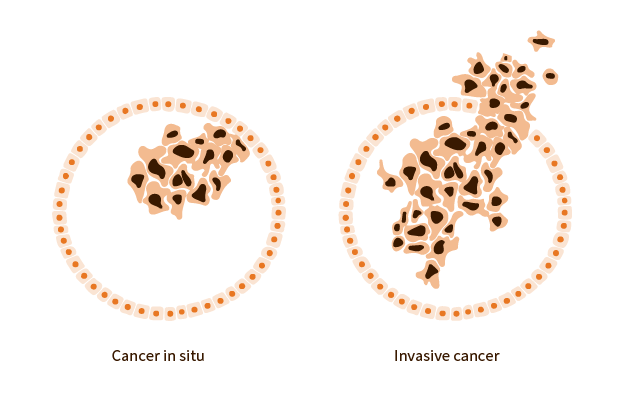
“In situ” is a medical term used to show that abnormal cells are still confined to the place where they started. They have not broken through into surrounding tissue, and they have not spread to other parts of the body. NCI defines carcinoma in situ as a condition in which abnormal cells that look like cancer cells are found only in the place where they first formed and have not spread to nearby tissue.
A simple way to think about it is this: the abnormal cells are still “contained.” They may look concerning, and they may have the potential to become invasive later, but they are still limited to the original layer or structure where they began.
Not always. This is where the term can become confusing. Some in situ diagnoses are described as stage 0 or non-invasive disease, while others are treated more like a warning sign or high-risk condition rather than an invasive cancer. The exact meaning depends on the organ, the pathology findings, and the specific diagnosis.
For example, NCI says ductal carcinoma in situ (DCIS) is not cancer, but it may be called a precancer because it can spread beyond the milk ducts and become invasive cancer. By contrast, the American Cancer Society says lobular carcinoma in situ (LCIS) is not considered cancer and typically does not spread beyond the lobule, although it increases the risk of developing invasive breast cancer later.
Even though in situ disease has not invaded nearby tissue, doctors still take it seriously because some of these abnormal cells may become invasive over time. NCI’s definition of carcinoma in situ notes that at some point these cells may become cancerous and spread into nearby normal tissue. That is one reason doctors often recommend treatment, close follow-up, or both, depending on the diagnosis.
This is also why patients should not assume that “in situ” means “nothing to worry about.” It usually means the problem is at an earlier stage than invasive cancer, but it still deserves proper evaluation and medical guidance.
The key difference is whether the abnormal cells have stayed contained or broken through into surrounding tissue. The American Cancer Society explains this clearly in breast cancer: in situ disease has not grown into the rest of the breast tissue, while invasive cancer has spread into the surrounding breast tissue.
That same basic idea applies more broadly in cancer medicine. “In situ” means the abnormal cells are still in their original place. “Invasive” means they have moved beyond that original boundary and started growing into nearby tissue.
One of the most familiar examples is ductal carcinoma in situ (DCIS) in the breast. NCI describes DCIS as abnormal cells in the lining of the milk ducts that have not broken out of the ducts and spread to other breast tissue. It is also commonly referred to as noninvasive breast cancer or stage 0 breast cancer.
Another example is squamous cell carcinoma in situ, which NCI says can occur in the skin, anus, bladder, uterus, cervix, head and neck, lung, vagina, and other parts of the body. These abnormal cells may become cancer and spread into nearby normal tissue, which is why they are treated seriously even before invasion occurs.
LCIS is another diagnosis that includes the words “in situ,” but it behaves differently. The American Cancer Society says LCIS is not considered cancer and does not typically become invasive breast cancer if left untreated, though it does raise a person’s future breast cancer risk.
The effectiveness of cancer treatment varies among each patient.
Often, but not always in exactly the same way. NCI specifically notes that carcinoma in situ is also called stage 0 disease. In common patient education, this usually refers to abnormal cells that are still confined and have not invaded nearby tissue.
However, not every condition with “in situ” in the name is discussed in exactly the same way across all cancer types. That is why patients should always ask what the term means for their specific diagnosis, rather than assuming it means the same thing in every organ or pathology report.
In situ disease is often found through screening, biopsy, or examination of tissue under the microscope. For example, NCI says most cases of DCIS are found on a mammogram during routine breast cancer screening, and the diagnosis is then confirmed with a biopsy.
This is one reason screening can matter. Because in situ disease may not cause symptoms and may not be visible from the outside, it is sometimes detected only when imaging or pathology reveals it.
Understanding this term can help patients make better sense of pathology results and treatment discussions. Hearing the word “carcinoma” can be frightening, but the phrase “carcinoma in situ” does not mean the same thing as invasive cancer. It describes abnormal cells that are still limited to where they began.
At the same time, in situ findings are still medically important. They may need treatment, careful monitoring, or additional evaluation, depending on the diagnosis and the patient’s situation. Knowing that “in situ” means contained, not invasive can make the discussion clearer and less overwhelming.
“In situ” is one of those medical terms that sounds technical but has a straightforward meaning: the abnormal cells are still in their original place. They have not yet spread into nearby tissue. In many cases, that means the condition has been identified at an earlier and more contained stage than invasive cancer.
For patients and families, the most useful question is often not just “Does my report say in situ?” but “What does in situ mean for this specific diagnosis, and what happens next?” That is where a clearer conversation with the care team becomes most valuable.
At Cancer A-Z, you can request a 15 mins free-of-charge discussion with our cancer professionals.
National Cancer Institute. Definition of in situ.
https://www.cancer.gov/publications/dictionaries/cancer-terms/def/in-situ
National Cancer Institute. Definition of carcinoma in situ.
https://www.cancer.gov/publications/dictionaries/cancer-terms/def/carcinoma-in-situ
National Cancer Institute. What Is Ductal Carcinoma in Situ (DCIS)?
https://www.cancer.gov/types/breast/breast-cancer-types/dcis
National Cancer Institute. Definition of squamous cell carcinoma in situ.
https://www.cancer.gov/publications/dictionaries/cancer-terms/def/squamous-cell-carcinoma-in-situ
American Cancer Society. Lobular Carcinoma in Situ (LCIS).
https://www.cancer.org/cancer/types/breast-cancer/non-cancerous-breast-conditions/lobular-carcinoma-in-situ.html
American Cancer Society. Types of Breast Cancer.
https://www.cancer.org/cancer/types/breast-cancer/about/types-of-breast-cancer.html
Precision medicine provides patients with clearer and more personalized treatment guidelines


Learn how precision medicine can help with your cancer treatment

The effectiveness of cancer treatment varies among each patient.