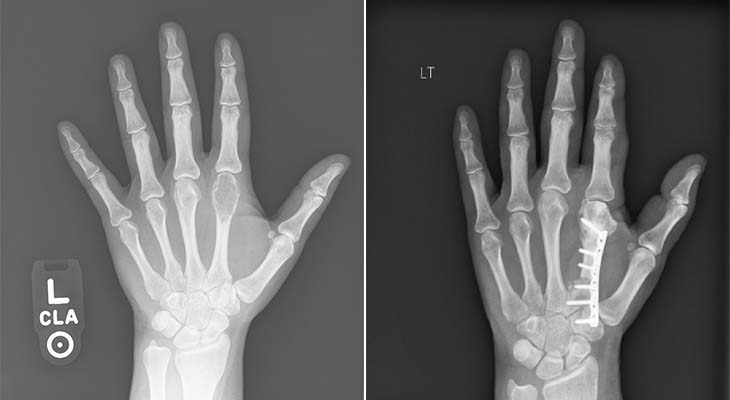
X射线

What Are X-rays?

X-rays are a type of medical imaging test that uses a small dose of ionizing radiation to create pictures of structures inside the body. Dense materials like bone or tumors appear white, while softer tissues show up in shades of gray or black.

X-rays are one of the oldest and most widely used imaging methods in medicine. They are quick, relatively inexpensive, and often the first test ordered when doctors suspect a problem.


How Are X-rays Used in Cancer?

  1. Detection & Screening
  • Chest X-ray may reveal suspicious lung nodules, masses, or enlarged lymph nodes.
  • Sometimes used to spot bone changes caused by cancers that spread to bone.

(Note: Chest X-rays are not recommended as a stand-alone screening tool for lung cancer, because small tumors may be missed.)

  1. Diagnosis & Staging
  • Helps doctors check whether cancer has spread to bones or lungs.
  • May guide further imaging (CT, MRI, PET scans) for detailed evaluation.
  1. Monitoring
  • Used during and after treatment to see if tumors are shrinking, stable, or growing.
  • Helps assess complications (e.g., lung infection, bone fracture).


What to Expect During the Test

  • Simple, painless, fast (usually <10 minutes).
  • You may be asked to hold your breath briefly while the image is taken.
  • Usually done standing or lying down depending on the area being examined.


Benefits

  • Fast and widely available
  • Low cost compared to CT or MRI
  • Helpful first-line tool


Risks & Limitations

  • Radiation exposure: Low dose, but repeated scans may add up.
  • Not as detailed as CT, MRI, or PET scans — may miss small tumors.
  • Cannot distinguish between cancerous and non-cancerous abnormalities (e.g., scar tissue vs. tumor).


Alternatives & Related Tests

  • CT Scan (Computed Tomography): More detailed, higher radiation dose.
  • MRI (Magnetic Resonance Imaging): No radiation, better for soft tissues.
  • PET Scan: Shows cancer activity and spread using radioactive tracers.
  • Ultrasound: Uses sound waves; no radiation.


Questions to Ask Your Doctor

  • Why are you recommending an X-ray in my case?
  • Could another test (CT, MRI, PET) give more accurate results?
  • How often will I need this test?
  • What do the results mean for my treatment plan?


Patient Tips

  • Bring prior imaging for comparison (CT, MRI, previous X-rays).
  • Wear clothing without metal zippers, snaps, or jewelry near the test area.
  • If you are pregnant or may be pregnant, tell your doctor before the scan.


References

了解精准检测

了解液体活检和化疗敏感性检测如何为您的护理方案提供个性化参考。

做出更明智的决策

获取相关知识,更积极地参与与医疗团队之间的护理讨论。

改善护理效果

了解精准医疗与代谢相关护理方式如何提升整体护理策略的参考价值。

今天就开始您的学习之旅

通过了解精准代谢肿瘤学相关知识,让自己更有力量,并在癌症护理过程中发挥更主动的参与作用。

需要更多信息?

我们的肿瘤相关专家团队可协助您理解诊断结果与护理方向选择。