
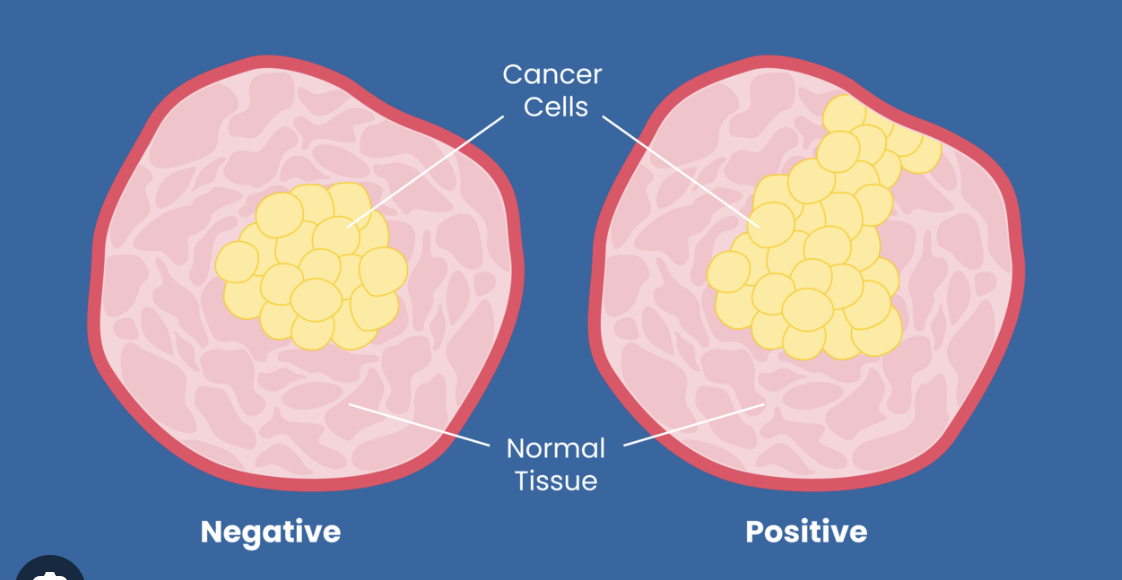
When a surgeon removes a tumor, they usually try to remove not only the tumor itself but also a small rim of surrounding tissue. That surrounding tissue is then examined by a pathologist under a microscope. The goal is to see whether cancer cells extend all the way to the edge of what was removed.
The pathology report may describe the margins in several ways. Common terms include negative margins, clear margins, or clean margins, which generally mean no cancer cells were seen at the edge. It may also describe positive margins, meaning cancer cells were found at the edge of the tissue.
Clear margins matter because they may lower the chance that cancer cells were left behind in the surgical area. This can be important when doctors are thinking about local recurrence risk and whether additional treatment may be needed.
That said, margins are only one part of the overall picture. Doctors also consider the cancer type, tumor size, grade, lymph node findings, stage, and biomarker results when deciding what comes next.
A clear margin is reassuring, but it does not always guarantee that every cancer cell in the body is gone. It means that, in the tissue that was removed and examined, the pathologist did not see cancer cells at the edge. Doctors still have to consider whether cancer may have spread elsewhere or whether microscopic disease could remain outside the surgical field.
This is why a person can have clear surgical margins and still be advised to have other treatment, depending on the cancer type and risk factors. Treatment recommendations are based on more than one finding.
A positive margin means cancer cells were found at the edge of the removed tissue. This can suggest that some cancer cells may still remain in the area after surgery. In that situation, doctors may consider another operation, called a re-excision, or other treatment such as radiation, depending on the type of cancer and the location of the tumor.
A positive margin does not always mean the same thing for every cancer. In some cancers, even a very small positive margin may change the next step significantly. In others, doctors may weigh the risks and benefits of more surgery against other treatment options.
Not always. Different cancers can have different standards for what is considered an adequate margin, and in some cases the pathology report may also describe how close the tumor was to the edge, not just whether it touched it.
That is why patients sometimes see wording such as “close margin” or a measurement in millimeters. A close margin is not automatically the same as a positive one, but it may still matter when doctors are deciding whether more treatment is advisable.
The effectiveness of cancer treatment varies among each patient.
The pathologist reports what is seen under the microscope, including whether the margin is clear or positive. The surgeon and oncology team then interpret what that means in the context of the full diagnosis.
This is one reason patients should not try to interpret margin status in isolation. A margin result is important, but it makes the most sense when explained alongside the rest of the pathology report and the treatment plan.
Even when margins are clear, doctors may still recommend radiation, systemic therapy, or close follow-up if there are other risk factors. Examples can include lymph node involvement, aggressive tumor biology, higher stage, or concern about disease beyond the surgical area.
This can be confusing for patients because “clear margins” sounds like the problem is fully solved. In reality, clear margins are encouraging, but they are only one piece of the larger medical picture.
Hearing that margins are clear is generally good news because it means no cancer cells were seen at the edge of the tissue removed during surgery. But margin status is not the only factor doctors use when planning next steps. Positive margins, close margins, tumor biology, lymph node findings, and overall stage can all influence what happens after surgery.
For patients and families, the most helpful question is often not just “Are the margins clear?” but “What do the margins mean in the context of this specific cancer?” That is the question your treatment team can answer best.
At Cancer A-Z, you can request a 15 mins free-of-charge discussion with our cancer professionals.
National Cancer Institute. Definition of margin.
https://www.cancer.gov/publications/dictionaries/cancer-terms/def/margin
National Cancer Institute. Surgical Pathology Reports.
https://www.cancer.gov/about-cancer/diagnosis-staging/diagnosis/pathology-reports-fact-sheet
American Cancer Society. Pathology Report After Surgery.
https://www.cancer.org/cancer/diagnosis-staging/tests/biopsy-and-cytology-tests/understanding-your-pathology-report/whats-in-pathology-report.html
American Cancer Society. Understanding Your Pathology Report.
https://www.cancer.org/cancer/diagnosis-staging/tests/biopsy-and-cytology-tests/understanding-your-pathology-report.html
American Cancer Society. Surgery for Soft Tissue Sarcomas.
https://www.cancer.org/cancer/types/soft-tissue-sarcoma/treating/surgery.html
American Cancer Society. Surgery for Bone Cancer.
https://www.cancer.org/cancer/types/bone-cancer/treating/surgery.html
American Cancer Society. Breast-conserving Surgery (Lumpectomy).
https://www.cancer.org/cancer/types/breast-cancer/treatment/surgery-for-breast-cancer/breast-conserving-surgery-lumpectomy.html
Precision medicine provides patients with clearer and more personalized treatment guidelines


Learn how precision medicine can help with your cancer treatment

The effectiveness of cancer treatment varies among each patient.