
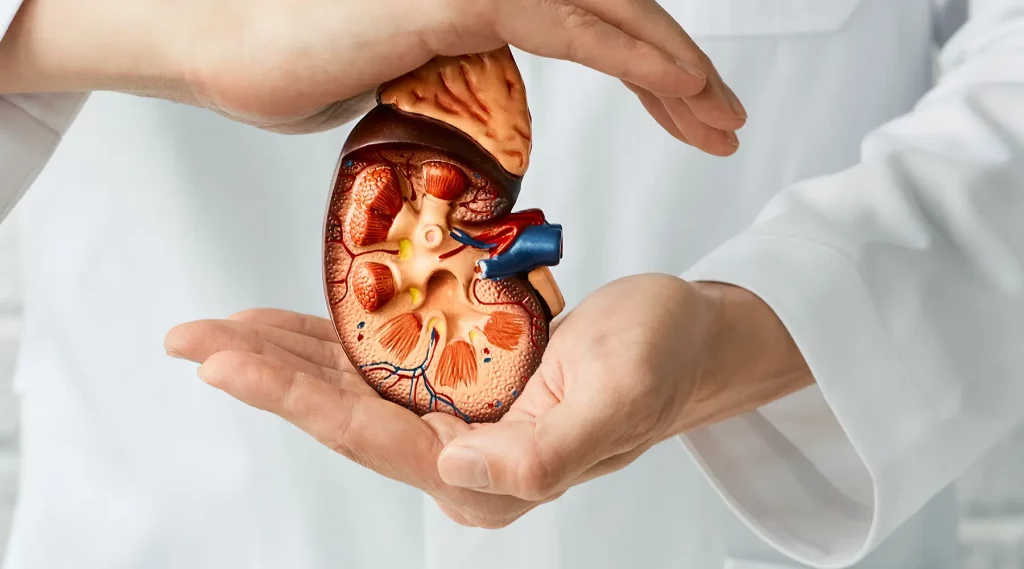
Kidney cancer is often described as a “silent” disease—and for many patients, that description is alarmingly accurate.
In fact, studies have shown that up to 50% of kidney tumors are discovered incidentally, meaning they are found during scans performed for unrelated reasons—such as back pain, abdominal discomfort, or routine health checks.
Not because of symptoms.
Not because something felt wrong.
But simply by chance.
And this is what makes kidney cancer particularly dangerous.
Unlike some other cancers, kidney tumors often do not cause noticeable symptoms in their early stages.
The kidneys are located deep inside the body, and small tumors can grow without affecting nearby structures right away. As a result, the body may not send clear warning signals early on.
Many people assume that serious conditions will always come with obvious signs. But with kidney cancer, this is often not the case.
By the time symptoms begin to appear, the disease may have already progressed.
The effectiveness of cancer treatment varies among each patient.
When kidney cancer does cause symptoms, they may include:
Blood in the urine (hematuria)
Persistent pain in the lower back or side
A lump or mass in the abdomen
Unexplained weight loss
Fatigue or anemia
However, these symptoms typically occur in more advanced stages of the disease.
At this point, the situation becomes more complex—not only physically, but also in terms of treatment decisions.
Cancer staging plays a critical role in determining treatment options and outcomes.
When kidney cancer is detected early and remains localized, treatment may be more straightforward—often involving surgery to remove the tumor.
But if the cancer has already spread (metastasized) to other parts of the body, treatment becomes more complicated. Doctors may need to consider:
Systemic therapies (such as targeted therapy or immunotherapy)
Combination treatment approaches
Ongoing monitoring of disease progression
In later stages, the goal may shift from curative treatment to disease control and quality of life.
This is why timing matters so much.
Modern imaging techniques such as CT scans, MRIs, and ultrasounds have significantly improved the detection of kidney tumors.
However, most of these scans are not performed unless there is a reason—such as symptoms or unrelated medical concerns.
This means many kidney tumors are only discovered incidentally, rather than through proactive screening.
Unlike cancers such as breast or colorectal cancer, there is currently no widely recommended routine screening program for kidney cancer in the general population.
This creates a gap between early biological changes and clinical detection.
Cancer does not begin at the moment a tumor becomes visible.
It starts much earlier—at the cellular and molecular level.
Before a tumor forms or becomes detectable through imaging, there may already be changes happening in the body, such as:
Alterations in gene expression
Changes in immune system activity
The presence of abnormal circulating cells
This is where the concept of precision medicine becomes increasingly important.
Precision medicine focuses on understanding the unique biological characteristics of each individual and their disease.
Instead of relying solely on imaging or symptoms, this approach looks deeper into how the body is functioning at a molecular level.
It aims to answer questions like:
Are there early biological signals associated with cancer risk?
How is the immune system responding?
Are there indicators of abnormal cellular activity?
By gaining this insight, doctors may be better equipped to make more informed decisions—especially in situations where traditional methods provide limited information.
One of the tools gaining attention in this space is liquid biopsy.
Liquid biopsy refers to blood-based testing that analyzes components related to cancer, such as:
Circulating tumor cells (CTCs)
Circulating tumor DNA (ctDNA)
Gene expression patterns
Immune system markers
Unlike traditional biopsies, which require tissue samples, liquid biopsy is minimally invasive and can be performed through a blood draw.
While it is not a replacement for imaging or diagnostic procedures, it can provide additional insights into what may be happening inside the body—sometimes even before structural changes are visible.
For many people, healthcare is still reactive.
We wait for symptoms.
We wait for something to feel wrong.
We wait for a diagnosis.
But with conditions like kidney cancer—where symptoms may appear late—this approach can be limiting.
The conversation is slowly shifting toward a more proactive mindset:
Are we waiting for symptoms…
or are we trying to understand our bodies earlier?
This does not mean replacing medical advice or routine care. Instead, it means exploring ways to gain more insight, especially for individuals who may be concerned about their health or risk factors.
While not everyone needs additional testing, some individuals may benefit from discussing their situation further, including those who:
Have a family history of cancer
Have been previously diagnosed with cancer
Are undergoing treatment and want to monitor changes
Feel concerned despite having no clear symptoms
Want to better understand their overall health status
In these cases, having a more detailed conversation with healthcare professionals can be valuable.
Kidney cancer’s “silent” nature is not just a medical fact—it is a reality that affects how and when the disease is discovered.
When half of tumors are found by accident, it raises an important question about how we approach awareness, detection, and understanding.
Early detection is not always straightforward.
Symptoms are not always reliable.
But awareness—and the willingness to look deeper—can make a difference.
references:
Capitanio, U., & Montorsi, F. (2016). Renal cancer. The Lancet, 387(10021), 894–906. https://doi.org/10.1016/S0140-6736(15)00046-X
Ljungberg, B., Albiges, L., Abu-Ghanem, Y., Bensalah, K., Dabestani, S., Fernández-Pello, S., Giles, R. H., Hofmann, F., Hora, M., Kuczyk, M. A., Kuusk, T., Lam, T., Marconi, L., Merseburger, A. S., Powles, T., Staehler, M., Volpe, A., & Bex, A. (2022). European Association of Urology guidelines on renal cell carcinoma: The 2022 update. European Urology, 82(4), 399–410. https://doi.org/10.1016/j.eururo.2022.05.006
Sun, M., Thuret, R., Abdollah, F., Lughezzani, G., Schmitges, J., Tian, Z., Jeldres, C., Perrotte, P., & Karakiewicz, P. I. (2018). Age-adjusted incidence, mortality, and survival rates of stage-specific renal cell carcinoma in North America: A trend analysis. European Urology, 59(1), 135–141. https://doi.org/10.1016/j.eururo.2010.10.029
Lee, C. T., Katz, J., Shi, W., Thaler, H. T., Reuter, V. E., & Russo, P. (2000). Surgical management of renal tumors 4 cm or less in a contemporary cohort. The Journal of Urology, 163(3), 730–736. https://doi.org/10.1016/S0022-5347(05)67801-5
Hsieh, J. J., Purdue, M. P., Signoretti, S., Swanton, C., Albiges, L., Schmidinger, M., Heng, D. Y. C., Larkin, J., & Ficarra, V. (2017). Renal cell carcinoma. Nature Reviews Disease Primers, 3, 17009. https://doi.org/10.1038/nrdp.2017.9
Wan, J. C. M., Massie, C., Garcia-Corbacho, J., Mouliere, F., Brenton, J. D., Caldas, C., Pacey, S., Baird, R., & Rosenfeld, N. (2017). Liquid biopsies come of age: Towards implementation of circulating tumour DNA. Nature Reviews Cancer, 17(4), 223–238. https://doi.org/10.1038/nrc.2017.7
Alix-Panabières, C., & Pantel, K. (2021). Liquid biopsy: From discovery to clinical application. Cancer Discovery, 11(4), 858–873. https://doi.org/10.1158/2159-8290.CD-20-1311
Precision medicine provides patients with clearer and more personalized treatment guidelines


Learn how precision medicine can help with your cancer treatment

The effectiveness of cancer treatment varies among each patient.