Overview
Hodgkin Lymphoma (HL), formerly known as Hodgkin’s Disease, is a malignant cancer of the lymphatic system — part of the body’s immune defense network.
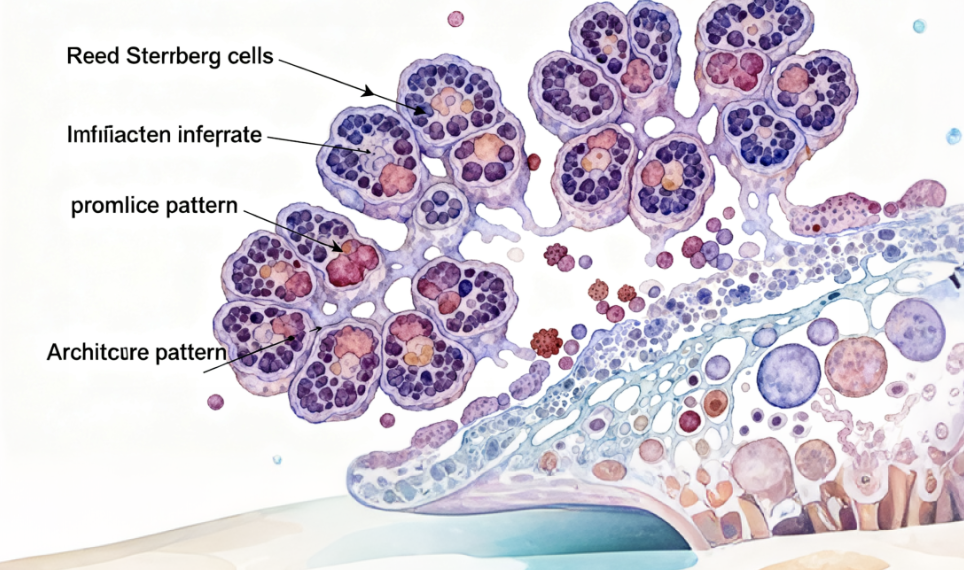
It arises from B lymphocytes (B-cells), which undergo abnormal transformation and form characteristic Reed–Sternberg cells, a diagnostic hallmark.
Hodgkin Lymphoma accounts for about 10% of all lymphomas and primarily affects young adults (ages 15–35) and older adults (>55 years).
It is one of the most curable cancers, especially when diagnosed early and treated with modern chemotherapy and targeted therapies.
Symptoms
- Painless swelling of lymph nodes (neck, underarm, or groin)
- Persistent fatigue or weakness
- Unexplained fever
- Drenching night sweats
- Unintentional weight loss (>10% in 6 months)
- Itching (pruritus) without rash
- Pain in lymph nodes after alcohol intake (unique but rare symptom)
- Cough, chest pain, or shortness of breath if mediastinal nodes are enlarged
Causes & Risk Factors
- Exact cause unknown, but associated with abnormal B-cell development.
- Risk factors include:
- Epstein–Barr Virus (EBV) infection
- Family history of lymphoma
- Male sex (slightly higher incidence)
- Weakened immune system (HIV/AIDS, organ transplant)
- Early adulthood or late adulthood age peaks
- Not inherited directly, but familial clustering may occur.
Diagnosis
- Physical examination: Lymph node enlargement without tenderness
- Imaging:
- CT or PET-CT scan – assesses lymph node involvement and staging
- MRI – used for specific organ involvement
- Lymph node biopsy: Confirms diagnosis by identifying Reed–Sternberg cells (large, binucleate “owl’s eye” cells).
- Immunohistochemistry: Positive for CD15 and CD30 markers (classic HL).
- Blood tests: May show anemia, elevated ESR, or abnormal lymphocyte counts.
- Bone marrow biopsy: Performed in advanced disease or abnormal blood findings.
- Staging: Uses the Ann Arbor classification (Stage I–IV), considering “A” (no systemic symptoms) or “B” (with fever, night sweats, weight loss).
Treatment Options
- Chemotherapy:
- Standard regimens: ABVD (Adriamycin, Bleomycin, Vinblastine, Dacarbazine) or AAVD (Adcetris®, Adriamycin, Vinblastine, Dacarbazine).
- 4–6 cycles depending on stage and response.
- Radiation therapy:
- Used for early-stage or bulky disease, often after chemotherapy.
- Modern techniques minimize exposure to heart and lungs.
- Targeted therapy:
- Brentuximab vedotin (anti-CD30 antibody-drug conjugate).
- Immunotherapy:
- Checkpoint inhibitors (nivolumab, pembrolizumab) used for relapsed or refractory disease.
- Stem cell transplantation:
- Autologous stem cell transplant for recurrent cases after remission induction.
- Clinical trials:
- Ongoing studies explore new immunotherapies and chemo-free regimens.
Prognosis
- Highly curable – especially in early stages.
- Overall 5-year survival rate:
- Stage I–II: >90%
- Stage III–IV: ~70–85%
- Key prognostic factors: Stage, presence of “B symptoms,” bulky disease, and response to initial therapy.
- Relapse rate: <10% for early-stage disease after full treatment.
- Late effects: Cardiac or pulmonary toxicity (from chemo/radiation), secondary cancers, or infertility — minimized with modern treatment protocols.
Living with this Cancer Type
- Highly curable – especially in early stages.
- Overall 5-year survival rate:
- Stage I–II: >90%
- Stage III–IV: ~70–85%
- Key prognostic factors: Stage, presence of “B symptoms,” bulky disease, and response to initial therapy.
- Relapse rate: <10% for early-stage disease after full treatment.
- Late effects: Cardiac or pulmonary toxicity (from chemo/radiation), secondary cancers, or infertility — minimized with modern treatment protocols.
Prevention & Screening
- No specific screening test for the general population.
- Risk reduction: Avoid immunosuppression where possible and maintain general health.
- Early detection: Seek medical attention for persistent lymph node swelling or systemic “B” symptoms.
- Survivor care: Lifelong monitoring for late effects (thyroid function, cardiac health, secondary malignancies).
FAQs
Q: Is Hodgkin Lymphoma curable?
A: Yes. It’s one of the most curable cancers, with over 90% of early-stage patients achieving long-term remission.
Q: How is Hodgkin Lymphoma different from Non-Hodgkin Lymphoma?
A: HL has Reed–Sternberg cells and a more predictable pattern of spread, while Non-Hodgkin Lymphomas are more diverse and often spread randomly.
Q: Can it return after treatment?
A: Relapse can occur in a small percentage, but many relapsed cases are still curable with stem cell transplantation or immunotherapy.
Q: Is it contagious or hereditary?
A: No, it is not contagious and rarely hereditary.
Resources
Q: Is Hodgkin Lymphoma curable?
A: Yes. It’s one of the most curable cancers, with over 90% of early-stage patients achieving long-term remission.
Q: How is Hodgkin Lymphoma different from Non-Hodgkin Lymphoma?
A: HL has Reed–Sternberg cells and a more predictable pattern of spread, while Non-Hodgkin Lymphomas are more diverse and often spread randomly.
Q: Can it return after treatment?
A: Relapse can occur in a small percentage, but many relapsed cases are still curable with stem cell transplantation or immunotherapy.
Q: Is it contagious or hereditary?
A: No, it is not contagious and rarely hereditary.
Understand Precision Testing
Learn how liquid biopsy and chemo sensitivity testing can personalize your treatment plan.
Make Informed Decisions
Gain knowledge to actively participate in treatment discussions with your healthcare team.
Improve Treatment Outcomes
Discover how precision medicine and metabolic therapies can enhance treatment effectiveness.
Start Your Educational Journey Today
Empower yourself with knowledge about precision metabolic oncology and take an active role in your cancer care journey.
Need More Information?
Our team of oncology experts is here to help you understand your diagnosis and treatment options.